“Care matters,” she said.
Then she smiled.
Not politely. Not strategically. Not the faint social curve she gave donors.
A real smile.
Grant felt it land somewhere dangerous.
One year after the gala that ruined him, an invitation arrived.
Root & River Foundation Seventy-Sixth Anniversary Gala.
Sterling Grand Hotel.
Black tie.
Grant set the envelope on his desk and stared at it until Elise, who had become less afraid of him over the past year, finally said, “Are you waiting for it to apologize first?”
He looked up. “I’m considering not going.”
“Because you’re not invited?”
“I’m invited.”
“Because people will stare?”
“They should.”
“Then go.”
Grant frowned.
Elise shrugged. “For what it’s worth, you’re less terrifying when you’re ashamed in the correct direction.”
He almost smiled.
That evening, Hannah called.
“My grandfather wants you there,” she said.
Grant stood in his kitchen, looking at the city lights beyond the glass.
“And you?”
A pause.
“I want you there too.”
He closed his eyes briefly.
“All right.”
“Grant?”
“Yes?”
“Don’t wear armor.”
He looked toward the closet where his most expensive tuxedo hung like a black flag.
“I’ll try not to.”
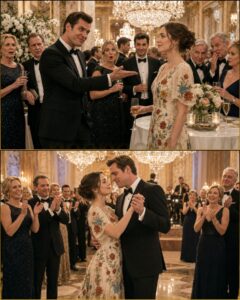
The next night, Grant returned to the Sterling Grand Hotel without Preston, without a press team, without a watch worth mentioning, and without any illusion that the room belonged to him.
People noticed him immediately.
Some whispered. Some smiled too brightly. Some looked away with the discomfort of those who had enjoyed his downfall online but did not want to acknowledge it in person. Grant accepted all of it. Memory was part of consequence.
He wore a plain black tuxedo and, inside his jacket pocket, carried the ugly embroidered flower.
The ballroom looked almost exactly as it had the year before. The chandeliers still burned. The champagne still climbed its glass tower. The same marble floor shone beneath his shoes, though he could not look at one spot near the stage without remembering broken glass.
Then he saw Hannah.
She wore the same dress.
Ruth Bellamy’s dress.
Cream cotton. Rust vines. Blue flowers. Gold thread. Little houses stitched along the hem, leaning into hills that no longer looked small to him. In a room full of diamonds, the dress did not compete. It did not need to. It carried its own light.
Hannah approached him.
“Careful,” she said. “People may think you have opinions about my dress.”
Grant swallowed. “I do.”
Her eyebrow lifted.
“It is the most valuable thing in this room.”
“Valuable,” she repeated, “or expensive?”
“Valuable,” he said. “I learned the difference.”
Her expression gentled.
Before she could answer, the lights dimmed.
Grant’s stomach tightened.
Jeremiah Bellamy stepped onto the stage to a standing ovation. He moved more slowly than the year before, leaning hard on his cane, but his presence filled the ballroom with old authority.
“Sit down before you make me sentimental,” he told the crowd.
Laughter rippled through the room as people took their seats.
Jeremiah adjusted the microphone.
“A year ago,” he said, “something happened in this ballroom that many of you saw, shared, judged, discussed, and perhaps enjoyed more than you should have.”
The room shifted.
Grant felt every eye trying not to look at him.
He kept his gaze on Jeremiah.
“A man said something cruel because he saw a handmade dress and mistook humility for weakness. My granddaughter answered with grace because she has better manners than I do.”
More laughter, softer this time.
“I considered several responses,” Jeremiah continued. “Most of them were un-Christian and satisfying.”
Hannah covered her mouth, but Grant saw her smile.
“But Root & River was not built to prove that people never fall short. If that were the standard, none of us would be allowed through the front door. This foundation was built on the belief that dignity is not something we grant to the deserving. It is something we recognize in one another before we know who has money, who has power, or who can help us.”
The old man turned slightly.
“Grant Calder, come up here.”
Grant’s heartbeat struck hard.
For a second, the old instinct screamed at him to refuse. A stage meant exposure. A microphone meant loss of control. A room full of donors meant danger.
Then he felt Hannah’s hand touch his sleeve.
Not pushing. Not rescuing.
Just there.
Grant walked to the stage.
The distance felt longer than it had looked. He climbed the steps, took the microphone from Jeremiah, and faced the room where he had once believed he was safest.
He saw board members, reporters, executives, philanthropists, politicians, artists, doctors, and donors. He also saw Miss Maeve near the front, sitting beside Jasmine, who gave him a look that clearly said, Do not embarrass us after all that needle training.
Grant breathed.
“A year ago,” he began, “I mocked a woman’s dress in this room. I did it quietly enough to pretend it was not public, but loudly enough to make sure she heard me. That tells you something important. I wanted the injury without the accountability.”
No one moved.
“I could tell you I did not know who Hannah Bellamy was. That would be true, but it would not help me. Respect that depends on identity is not respect. It is calculation.”
Hannah looked down.
Grant continued.
“The harder truth is that I recognized that dress before I understood it. Not the exact dress, but what it represented. Handwork. Poverty. Patience. Women making beauty from what little they had. My mother, June Calder, sewed clothes in our kitchen in West Virginia. Her hands paid for my schoolbooks. Her needle kept food in our house. And I spent years treating that memory like a stain instead of an inheritance.”
His voice roughened.
“I was ashamed of the wrong thing. I was ashamed of where I came from, when I should have been ashamed of how quickly I abandoned it.”
He reached into his jacket and took out the small embroidered square. Holding it up in that glittering ballroom felt absurd and terrifying.
“I made this at Bellamy House. Badly. Jasmine Carter, who is here tonight and who has never shown unnecessary mercy, says it looks like a flower that lost a bar fight.”
The room laughed, and Jasmine called from the front, “I said weather event!”
Grant smiled briefly.
“She was generous. But every crooked stitch taught me something I had managed not to learn from contracts, towers, or bank accounts. Value is not always clean. It is not always polished. It does not always enter through the front door wearing a label we recognize. Sometimes it sits under a kitchen lamp in tired hands. Sometimes it takes two hundred hours and is still called too expensive by someone who has never made anything but a profit.”
The room was silent again.
Grant turned toward Hannah.
“Hannah, I am sorry. Not because I was caught. Not because the video damaged my reputation. I am sorry because I looked at you and chose not to see you. I used my old shame as a weapon and made you stand in front of it. You did not deserve that. No one does.”
Hannah’s eyes shone, but she did not look away.
Grant lowered the microphone.
For a moment, he thought it was over.
Then Jeremiah took the microphone back.
“Good,” the old man said. “Nobody fainted.”
A small wave of laughter passed through the room, relieving the pressure.
“Now, I have an announcement. Calder Holdings and Root & River will not be moving forward with the original Calder Center for American Renewal.”
A murmur rose.
Grant turned, surprised. He had known the original deal was dead, but not that Jeremiah intended to announce it like this.
Jeremiah’s eyes twinkled.
“In its place, an independent trust has been created. It will be governed not by donors, not by corporate officers, but by community representatives, nurses, cooperative leaders, and artisans from the regions it serves. Its purpose will be rural health access, fair-pay textile partnerships, apprenticeships, and emergency support for women-led local enterprises.”
The screen behind him lit up.
Two names appeared.
THE RUTH BELLAMY AND JUNE CALDER DIGNITY TRUST.
Grant stopped breathing.
The room blurred.
He stared at his mother’s name in white letters above the stage.
June Calder.
Not hidden. Not erased. Not corrected into something smoother.
Seen.
He turned toward Hannah, but Jeremiah was still speaking.
“Some of you may wonder why Mrs. June Calder’s name is there. Mr. Calder wondered too, about thirty seconds ago.”
Soft laughter moved through the room, but Grant barely heard it.
Jeremiah reached into his jacket and unfolded a piece of paper protected in a clear sleeve.
“After last year’s events, I asked our archivist to look through early Root & River records from West Virginia. We found a letter from 1989. It came with a five-dollar money order. Five dollars, when five dollars was not small to the woman who sent it.”
Grant gripped the edge of the podium.
Jeremiah read.
“Dear clinic people, you helped my boy when his fever would not break and I had no insurance. I cannot pay what it was worth. Please take this little bit for the next mother who is scared. I sew, so if you need curtains or mending, I can help. God bless you. June Calder.”
The ballroom disappeared.
Grant was no longer in Manhattan. He was nine years old, burning with fever, lying under a thin blanket in a clinic waiting room while his mother argued softly with a nurse because she had no money. He remembered a paper cup of water. He remembered his mother’s hand on his forehead. He remembered, dimly, a doctor saying, “We’ll figure out the payment later.”
He had forgotten.
No.
He had chosen not to remember.
Jeremiah lowered the letter.
“Long before Grant Calder had a fortune to give, his mother gave what she had. Root & River does not measure dignity in zeros. Ruth Bellamy and June Calder never met, but they believed the same thing: that care given quietly can outlive the person who gives it.”
Grant looked at Hannah.
She was crying now, openly, without embarrassment.
He understood then that this was not a reward. It was not forgiveness wrapped in ceremony. It was something far more powerful.
It was restoration.
Hannah had not helped put his mother’s name on the trust to flatter him. She had done it to return him to the truth he had spent his life outrunning.