
“I arrived at Christmas dinner limping, my foot in a cast, after a “little incident” with my daughter-in-law. My son laughed and said, “My wife just wants you to learn from this, Mom.” He had no idea the doorbell that rang next was from the authorities I had called myself.
I came to Christmas dinner with a cast on my foot, a voice recorder in my coat pocket, and two months of patience folded behind my smile.
The dining room smelled like roasted turkey, cinnamon candles, and the kind of expensive wine people pour when they want a room to look warmer than it is. My foot throbbed inside the plaster every time I shifted my weight. The small recorder pressed against my ribs like a second heartbeat.
Everyone stared when I stepped through the doorway.
My son Jeffrey looked at the cast first. Then he looked at my face. Melanie, my daughter-in-law, did not look sorry.
That told me enough.
My name is Sophia Reynolds. I am sixty-eight years old, and for most of my life I believed family was the safest place a person could stand. I learned the hard way that blood can open the front door for people who were never supposed to be trusted with a key.
Three years earlier, my husband Richard died of a sudden heart attack. Thirty-five years of marriage ended between one breath and the next. We had built our life from flour, coffee, early mornings, and tired hands into four bakeries across New York City. Richard handled the big decisions. I handled people. Together, we made something solid.
After the funeral, the house in Brooklyn felt too quiet. The kitchen still smelled like him in the mornings, like coffee grounds and the rye bread he used to slice too thick. His work shoes stayed by the mudroom door for six weeks because moving them felt like admitting he was gone.
Jeffrey came to the wake with Melanie and held me too tightly. Back then, I thought he was grieving with me. Now I know he was measuring how alone I was.
Four months later, they moved into my house.
At first, I was grateful. Jeffrey cooked Sunday dinner. Melanie came with me to the farmers market and carried the paper grocery bags like she wanted to be helpful. They said the big house was too much for me. They said they worried about my safety. They said Richard would want me surrounded by family.
Loneliness can make a locked door look like a welcome mat.
The house was worth more than $2 million. The bakeries, savings, and accounts brought the total close to $4 million. Jeffrey was my only child, my only heir. But as long as I was alive, everything Richard and I built still belonged to me.
The first request came six months after they moved in.
Jeffrey needed $50,000 for a specialization course because his company might be restructuring. Three weeks later, Melanie needed $30,000 for her mother’s surgery. Then came $40,000 for an investment Jeffrey swore would double in six months, $25,000 after Melanie’s car accident, and another $30,000 for a partnership opportunity that never became anything.
By December, I had handed over $230,000.
Not gifts, they said. Loans. Temporary help. Family taking care of family.
But family does not always take care of you. Sometimes it studies where you keep the checkbook.
The morning everything changed, I was making coffee before sunrise. The house was silent except for the kettle clicking on and the floorboards giving their usual little creak under my slippers. Then I heard Melanie’s voice through the hallway.
“When is she going to die?”
She said it as casually as if she were asking whether we were out of milk.
Jeffrey laughed nervously and told her not to talk like that. But Melanie kept going. She said I was sixty-eight and could live another twenty or thirty years. She said they could not wait that long. She talked about my will, my power of attorney, and papers I might sign if they convinced me I was getting confused.
Then she used one word that made my hand go cold around the mug.
Senile.
Jeffrey did not defend me. Not really. He only mumbled that I was his mother. Melanie asked how much they had already taken. He said around $200,000, maybe more. She said they could still get another $100,000 or $150,000 before I suspected anything.
I went upstairs, locked my bedroom door for the first time since they moved in, and sat on the bed I had shared with Richard.
That was the morning the old Sophia died.
Not loudly. Not dramatically. Quietly, with cold coffee cooling downstairs and my only son discussing my death like a line item.
For the next few days, I said nothing. I smiled when Melanie asked if I wanted tea. I thanked Jeffrey when he offered to pick up groceries. I watched the mail, the bank envelopes, the way conversations stopped when I entered the room.
Then I went to see Robert Morris, the accountant who had handled the bakery books since Richard was alive.
Robert and I spent three hours inside his downtown office with the blinds half-open and a stack of printed ledgers between us. He pulled the business accounts, the personal transfers, the digital signature logs, and the authorizations Jeffrey had access to because I had trusted him after Richard died.
The truth was worse than betrayal.
Over ten months, $68,000 had been diverted from the bakery accounts in small withdrawals. $2,000 here. $3,000 there. Always on Thursdays, while I was at yoga. Always with my digital signature.
I stared at the report until the numbers blurred.
$298,000.
That was what their love had cost so far.
Robert canceled every power of attorney and access authorization that afternoon. He prepared a detailed suspicious-transaction report, printed the transfer ledger, and told me I should consider making a police report.
I told him I would.
But first, I needed them to talk.
For two months, I became very quiet. Quiet enough to be underestimated. I kept copies of bank emails. I saved voicemails. I wrote down dates, times, amounts, and excuses in a notebook I kept inside an old recipe tin marked “Richard’s Christmas Cookies.”
Then the “little incident” happened.
Three days before Christmas, Melanie and I were alone in the kitchen. I had asked her why a bank envelope addressed to me had been opened and tucked behind the microwave. Her sweet face hardened so fast it was almost impressive. She stepped close, lowered her voice, and told me old women fell all the time when they started getting confused.
I reached for the envelope.
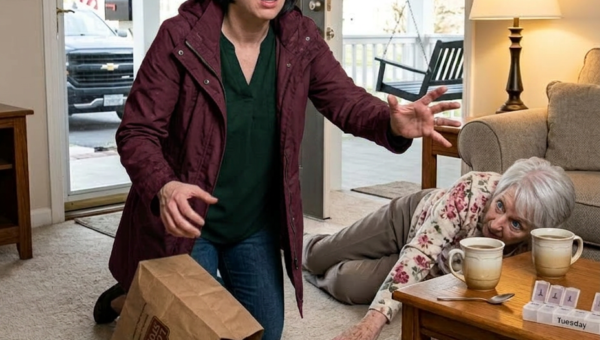
She shoved me.
My hip hit the island. My foot twisted under me. The crack was small, sharp, and final. For one second, I saw the kitchen ceiling, the hanging copper pans, the Statue of Liberty magnet on the refrigerator, and Melanie standing over me with her mouth parted like she had surprised herself.
Then she bent down and whispered, “Maybe now you’ll stop snooping.”The ambulance had taken me away while Jeffrey was still at work. Melanie had lied to him, of course, telling him I had simply tripped over my own slippers. When Jeffrey came to visit me in the hospital room, he didn’t ask how I was. He just looked at my plastered leg, sighed, and told me I was getting too frail to live alone.
They thought the cast was my defeat. They didn’t know it was the final piece of evidence.
Now, sitting at the head of the Christmas dining table, I watched Melanie smoothly carve the turkey. The diamond bracelet on her wrist—bought with my money—glinted in the candlelight.
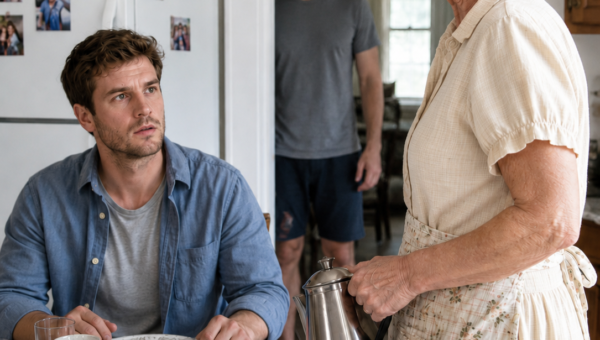
“”You’re awfully quiet tonight, Mom,”” Jeffrey said, taking a sip of his wine. He chuckled, a lazy, patronizing sound. “”Still upset about your little incident? Melanie told me what happened. You really need to be more careful. My wife just wants you to learn from this, Mom. You’re getting clumsy in your old age. Maybe it’s time we start looking at assisted living facilities.””
Melanie offered a sweet, venomous smile from across the table. “”We just want what’s best for you, Sophia. The house is just too big for you to manage, especially with your memory slipping.””
I reached into my coat pocket beneath the napkin, my fingers finding the small plastic switch on the voice recorder. I clicked it off, knowing it had just captured everything I needed.
“”I have learned from it, Jeffrey,”” I said, my voice steady, devoid of the fear they expected. “”I’ve learned exactly what the two of you are.””
Jeffrey lowered his fork, his brow furrowing. “”What is that supposed to mean?””
“”It means,”” I said, leaning back in my chair and looking directly at my daughter-in-law, “”that old women don’t always fall because they are confused, Melanie. Sometimes they are pushed by thieves.””
Melanie’s face tightened. “”Jeffrey, listen to her. She’s having one of her episodes again. This is exactly what I was talking about—””
“”I spoke with Robert Morris two weeks ago,”” I interrupted smoothly. The name hit the room like a sudden drop in temperature. Jeffrey froze. “”I have the ledger of the $68,000 you stole from the bakery accounts using my forged digital signature. I have the bank statements for the $230,000 in fraudulent ‘loans.’ And right here in my pocket, I have a recording of you both discussing how much more you could bleed from me before I died.””
Jeffrey’s fork clattered against his porcelain plate. His face went entirely white. “”Mom… you… you’re mistaken. We can explain—””
“”There’s nothing to explain, Jeffrey,”” I said, my voice cold as ice. “”You didn’t defend me. You measured my loneliness and turned it into an acquisition strategy.””
Melanie slammed her hands on the table, her polite mask completely shattering. “”You ungrateful old bitch! We moved in here to take care of you! You think anyone is going to believe your senile ramblings over us?””
Right on cue, the sharp, authoritative chime of the front doorbell rang through the house.
The sound cut through the room like a blade. Neither Jeffrey nor Melanie moved. They stared at the hallway, paralyzed.
“”Who is that?”” Jeffrey whispered, his voice trembling. “”Did you invite someone?””
“”I did,”” I said, adjusting the napkin on my lap. “”I called them myself right before I left the hospital. Go answer it, Jeffrey. Don’t keep our guests waiting on Christmas.””
With shaking legs, Jeffrey stood up and walked toward the foyer. Melanie followed closely behind him, her eyes darting around the room like a cornered animal. I gripped my cane, stood up from the head of the table, and slowly limped after them, the heavy thud of my cast echoing on the hardwood floor.
When Jeffrey opened the heavy oak front door, the winter wind rushed into the hallway, carrying a flurry of snow. Standing on the porch were two New York City police officers and a plainclothes detective holding a manila folder.
“”Jeffrey Reynolds? Melanie Reynolds?”” the detective asked, flashing his badge.
“”Yes?”” Jeffrey choked out, his hands visibly shaking. “”Is there a problem, officer?””
“”We’re here executing an arrest warrant,”” the detective stated calmly, stepping inside the warm foyer. “”You are both being charged with grand larceny, financial exploitation of the elderly, and in your case, Mrs. Reynolds, second-degree assault.””
“”Assault?!”” Melanie shrieked, backing away toward the stairs. “”This is ridiculous! She tripped! She’s crazy!””
I limped into the foyer, standing tall beside the staircase. I pulled the small digital recorder from my pocket and handed it to the detective. “”Here is the audio from tonight, Detective. It includes the verbal admission of financial coercion and the confirmation of the assault three days ago.””
The detective took the recorder and nodded respectfully. “”Thank you, Mrs. Reynolds. Officers, collar them.””
Jeffrey burst into tears as the steel handcuffs clicked around his wrists. “”Mom, please! We’re family! You can’t do this to your own son! Dad wouldn’t want this!””
I looked at my son—the boy I had raised, the boy who had watched his father build a legacy only to try and tear it away from his grieving mother. My heart didn’t break. It had already broken months ago, and now it was just stone.
“”Your father built those bakeries with his own two hands, Jeffrey,”” I said, my voice dropping to a fierce, quiet whisper. “”He taught you to be a man, not a parasite. You stopped being my family the moment you started wishing for my grave.””
Melanie screamed and cursed as she was led down the snow-covered front steps, her expensive jewelry clinking loudly against the metal handcuffs. Jeffrey kept his head bowed, sobbing hysterically as he was pushed into the back of the police cruiser.
The neighbors were already peering through their windows, watching the flashing red and blue lights paint the snowy Brooklyn street.
The detective closed the door behind them, leaving the house in absolute, beautiful silence.
I walked back into the dining room. The turkey was still warm, the candles were still burning, and the table was set for three. I sat back down at the head of the table, poured myself a full glass of the expensive wine, and raised it toward the empty chair where Richard used to sit.
“”Merry Christmas, Richard,”” I whispered, taking a slow sip. “”The house is finally clean.”””