
My husband left my father’s funeral to travel with his mistress.
But at 3 a.m.
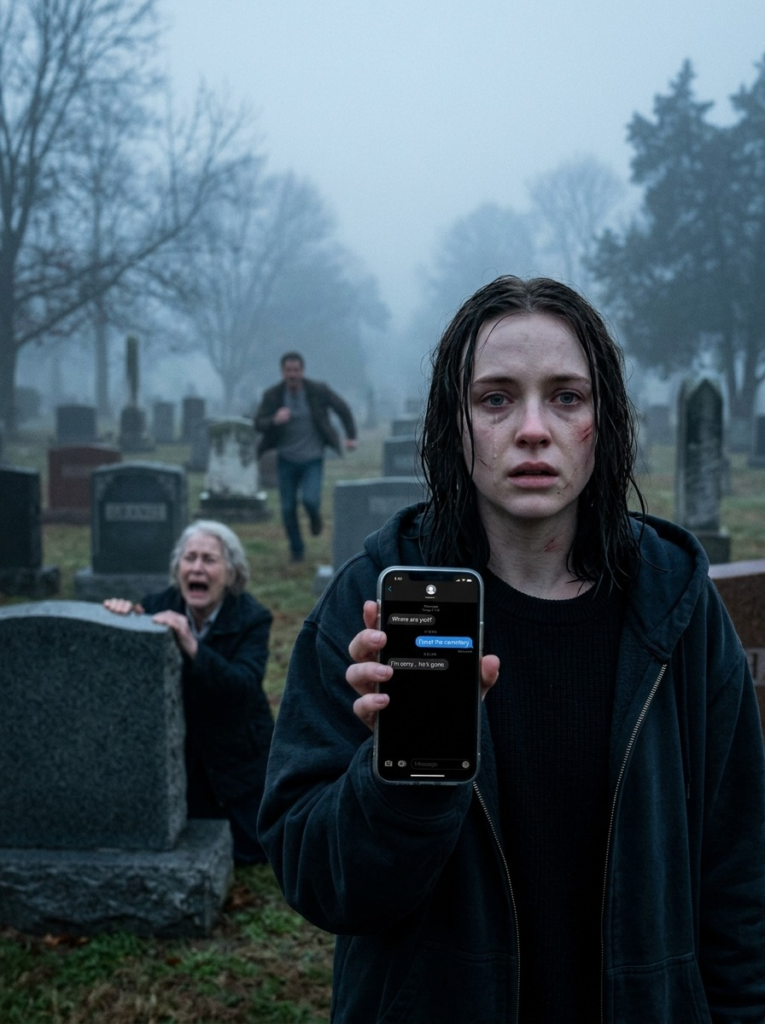
I received a message from my father: “My daughter, it’s me.
Dad
Come to the cemetery immediately and very quietly.”
Even now, when I replay that night in my head, that is the sentence that still makes my skin go cold.
My father, Thomas Carter, died on a Thursday afternoon after years of heart failure.
|Not the dramatic kind people picture in movies.
His illness was slower, crueler, and somehow more exhausting.
It took his breath first, then his strength, then his ability to hide how frightened he really was.
By the time he died, every room in my parents’ house held some trace of the battle: pill organizers on the counter, oxygen tubing by his chair, hospital paperwork stacked in neat piles because my father hated mess even when he was sick.
I was his only daughter.
He used to call me Missy when I was little and Melissa whenever he wanted me to know he was being serious.
He was the one who taught me to change a tire, balance a checkbook, and spot the difference between confidence and charm.
Looking back, that last lesson might have saved me if I had remembered it sooner.
My husband, Andrew, had been all charm when we met.
He knew how to smile at waitresses, how to speak softly to strangers, how to make every selfish instinct sound like ambition.
For the first two years of our marriage, I mistook calculation for stability.
By the fourth year, I knew he was colder than he wanted the world to believe, but I kept explaining him away.
Stress from work.
Pressure.
Money worries.
The usual excuses women make when they are not ready to admit that the person beside them is not confused or damaged or temporarily distant.
He is simply showing you who he is.
My father saw Andrew more clearly than I did.
He never pushed me to leave him.
That wasn’t his style.
But during his last month in the hospital, when Andrew thought I was out getting coffee, my father took my hand and asked me a strange question.
Has he always watched people’s money the way he watches mine?
I laughed at the time because it sounded petty, almost paranoid.
Andrew had been handling some of the insurance calls, helping organize bills, talking to doctors with me.
I thought my father was embarrassed by needing help.
Now I know he was warning me in the only way he could without starting a war at his bedside.
At the funeral, Andrew’s mask slipped in a way I could never unsee.
My father had been buried less than half an hour when Andrew leaned down and murmured that he had business to handle.
He didn’t squeeze my hand.
He didn’t ask if I wanted him to stay.
He simply left.
That night my cousin Jenna called by accident while trying to reach someone else, and in the middle of apologizing she let something slip.
She had seen Andrew at the airport with a blonde woman in medical scrubs under a coat.
Not work clothes, she said.
More like someone trying to cover what she was wearing.
I asked her to describe the woman, and by
the time she mentioned the sharp bob haircut and the silver badge clip on her purse, I felt physically sick.
Kendra Walsh.
My father’s hospice nurse.
I didn’t even cry then.
I was too stunned.
I just sat on the edge of my childhood bed in my funeral dress, numb with a kind of humiliation so deep it seemed to hollow out my bones.
My father was gone.
My husband had left me hours after the burial.
And the woman he left with was one of the last people trusted to care for my father.
My mother, Elaine, finally cried herself to sleep in the next room.
I stayed awake under the old glow-in-the-dark stars that were still stuck to my ceiling from high school.
It was almost funny, in a bitter way.
I was thirty-four years old, grieving like a child, abandoned by my husband, and back in the room where my father once sat beside me after nightmares.
Then my phone buzzed at 3 a.m.
The message came from an unknown number.
My daughter, it’s me.
Don’t panic.
Come to the cemetery immediately and very quietly.
I need you.
It used my father’s voice so perfectly that it felt like someone had reached into my chest and squeezed.
Come very quietly was his phrase.
He had used it for private talks my entire life.
Only someone close to him would know that.
I left without waking my mother.
I did not call the police because I was not thinking like a careful person.
I was thinking like a daughter whose dead father had just spoken in the language only he used with her.
The cemetery was almost empty, washed in weak yellow light.
My father’s phone was propped against his gravestone, screen glowing.
Fresh footprints marked the wet soil.
Before I could decide whether to grab the phone or run, Walter Boone, the cemetery caretaker, stepped from the shadows and said my father had asked him to do this.
Boone handed me an envelope with my name written in my father’s handwriting.
My father, he explained, had visited the cemetery weeks earlier and left instructions.
If Andrew abandoned the funeral early, Boone was to place the phone on the grave after midnight and wait nearby in case I came alone.
Inside the envelope, my father had written: If Andrew leaves before the condolences are over, stop trusting what you think you know.
Start with the phone.
Then go to the red toolbox in my workshop.
Do not tell your mother yet.
The phone unlocked with my birthday.
One audio file was waiting.
My father’s voice was weak but steady.
He said Andrew was not only unfaithful.
He was lying about money, pressing him to sign documents, and showing far too much interest in his medications.
My father had changed his will on Monday.
Andrew found out.
That, my father said, was why Andrew had suddenly become desperate.
He told me there was a key and a memory card hidden in the red toolbox in the workshop and instructed me to get to First National Bank, box 214, as soon as it opened.
Then came the line that changed everything.
If the man in the next video is who I think it is, Andrew didn’t do this alone.
drove back to the house on autopilot, my pulse hammering so hard I could feel it behind my eyes.
In the workshop, exactly where my father said it would be, I found a brass key, a memory card, and another note: Watch the video before you trust anyone.
I put the memory card into my laptop.
The first file showed my father’s bedroom from a hidden angle near the bookshelf.
The timestamp was two nights before he died.
Andrew walked in, opened the medication drawer, and switched one pill bottle for another.
Then he called someone and said, We just need one more day.
After the funeral, we disappear.
The second file made my stomach drop.
Kendra walked in wearing scrubs.
She went straight to Andrew, took a set of papers from him, and said, He won’t sign anything if Melissa is here.
You said she’d be gone tonight.
Andrew answered, She was.
Her father called, and she ran back.
She always runs back for him.
Then he kissed her.
The third file was audio only, but I knew the male voice within seconds.
Victor Hale, my father’s attorney.