
The woman looked down at the bag of Tupperware, as if she were also carrying inside it all the months I had left them in front of that door.—”Come in,” I said, even though my apartment was a mess, even though the onion was still cut open on the chopping board, even though I felt that one extra word could break me. She walked in slowly. Not like a visitor. Like someone returning to a place where they left something buried.
She sat on the kitchen chair and placed the bag on her lap. I turned off the stove because the oil was starting to smoke. The smell of onion hung between us, harsh, familiar, much like any given afternoon with Mr. Arthur yelling at me from the hallway that my soup looked like mop water. —”My name is Claire,” she said. “I’m the oldest daughter.” I didn’t know what to say.
For months, Mr. Arthur had talked about his children the way one talks about people living in another country, even if they only lived forty minutes away. “Claire was always the most serious one,” he would say. “Even as a little girl, she sounded like a lawyer, even when asking for a popsicle.” I had imagined her as distant, cold, the kind of person who answers calls in a rush and sends money so they don’t have to send affection.
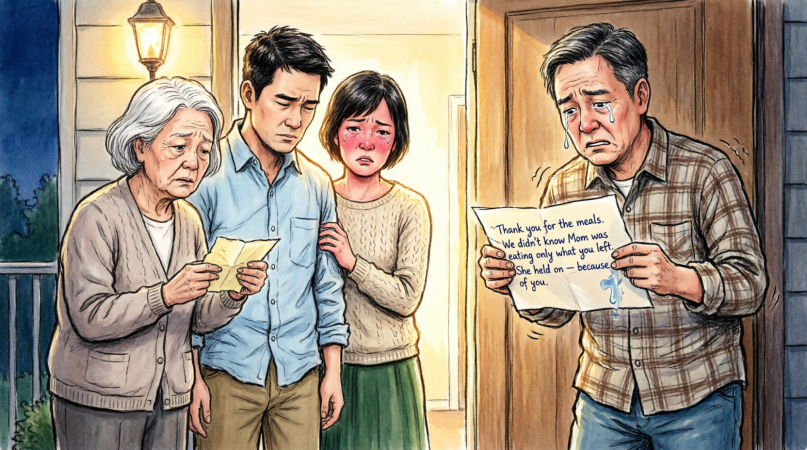
But the woman in front of me didn’t look cold.
She looked guilty.
And guilt, when it arrives late, ages you faster than the years.
—”My dad talked about you a lot,” she said.
I pressed my fingers against the table.
—”About me?”
She smiled without joy.
—”Not by your name. He never told us your name. He called you ‘the soup girl’.”
I felt a pang in my chest.
—”I’m not exactly a girl anymore.”
—”To him you were,” she replied. “To him, anyone who could still climb stairs without complaining was a kid.”
I wanted to laugh.
What came out sounded more like a sigh.
Claire opened the bag and took out my Tupperware containers one by one. They had been washed with an absurd delicacy. Some had lids that didn’t even close right anymore. One had a burnt corner because I once set it too close to the stove. Another had “lentils” written in marker. I recognized it and wanted to hug it, as if the plastic held something of his hands.
—”We found this in his kitchen,” she said. “They were all arranged on a shelf. Washed. Dried. Some had little pieces of paper inside.”
—”Paper?”
She swallowed hard.
She reached into the yellow envelope and pulled out several folded pieces of paper.
—”My dad started writing when he realized he was forgetting things. The doctor told us he should write down names, routines, medications. He turned it into something else.”
She handed me the first piece of paper.
Mr. Arthur’s handwriting trembled, but it was still elegant, the kind of old-school cursive learned from penmanship drills, not quick text messages.
I read:
“Monday. The neighbor brought soup. She said she had leftovers. She lies very poorly. The soup was good, but I’m not going to tell her because then she’ll get a big head. Reminder: she has a hidden laugh. Ask her for her name.”
I covered my mouth.
Not because I wanted to cry.
But because I was already crying.
Claire handed me another page.
“Wednesday. Tomato rice. It lacked a little garlic, but you can tell she made it with patience. When she knocked on the door, she didn’t run away. She stayed. That counts more than the garlic.”
Another one.
“Friday. Mild chili without any spice. What kind of punishment is it to live in America and not be able to eat spicy food? The neighbor said it was for my blood pressure. She scolded me exactly like Mary used to. It made me mad. It made me glad.”
The kitchen felt small.
As if the walls were closing in to listen, too.
—”We didn’t know,” Claire said.
Her voice broke at the edges.
—”We didn’t know how much he depended on you.”
I looked up.
—”He didn’t depend on me. I just left him food.”
Claire shook her head.
—”No. You don’t understand. He stopped eating almost entirely after he started getting confused. My brother would order him groceries through an app, I would come on Sundays… sometimes every other Sunday…” she closed her eyes. “We thought that was enough. That as long as he had beans, milk, bread, and medication, it was enough.”
I didn’t say anything.
Because I, too, had often thought that leaving a Tupperware and going back to my life was enough.
—”But the food was going bad,” she continued. “We would find rotting tomatoes, stale bread, unopened cans. He would say he had already eaten. He’d say he wasn’t hungry. He said food didn’t taste like anything to him anymore. And then you started knocking on his door.”
She looked toward the window, as if she could see her dad’s door from there.
—”In a notebook, he wrote that he got his appetite back because someone was waiting for his response.”
Something inside me folded.
I didn’t know a person could be sustained by soup.
I didn’t know a teasing comment could be a walking cane.
I didn’t know that sometimes you aren’t feeding the body, but the reason to get up from the chair.
Claire pulled a different piece of paper from the envelope. Thicker. Carefully folded. It had my name written on it, even though it wasn’t my name.
It said:
“For my Mystery Neighbor.”
—”This is the note,” Claire whispered. “He wrote it three days before he died. That day my brother came to see him, and he handed it to him. He told him: ‘When I’m no longer here, find her. But first, ask for her forgiveness.’”
I looked at her, confused.
—”Forgiveness? For what?”
Claire pressed her lips together.
—”Because we… we got mad at you.”
For a second, I didn’t understand.
—”At me?”
—”When we found the Tupperware, at first we thought horrible things. That maybe you were charging him. That maybe you had sneaked into his house. That maybe you wanted something from him. My brother was very upset. My dad had some savings that didn’t show up in the bank, and…” she put a hand to her forehead. “It was unfair. It was cruel to even think it. But when a family knows they’re guilty, they look for someone to blame so they don’t have to look in the mirror.”
I stood still.
The onion on the chopping board started crying for both of us.
—”You didn’t know me,” I said, because it was the only thing I could say.
—”No,” she replied. “And yet you knew him better than we did in his final months.”
The phrase fell onto the table like a broken plate.
I wanted to defend her from herself. Tell her no, that surely wasn’t true, that you can’t erase a whole lifetime for a few months of soup. But I remembered Mr. Arthur calling me Mary. I remembered the television turned on so the house wouldn’t sound dead. I remembered his laugh when I told him that if he kept criticizing my food, I was going to start charging him.
And then I understood that Claire’s pain didn’t need quick comfort.
It needed to stay there.
To breathe.
—”Can I read it?” I asked.
She nodded.
I took the paper.
My hands were shaking so much the letters danced.
“Mystery Neighbor:
If you are reading this, it means i’ve already done the rude thing of dying without saying a proper goodbye. I’m sorry. When you get old, you lose a lot of things: hair, strength, memory, friends, teeth, patience. But I hadn’t lost my shame yet, and I’m embarrassed to leave owing you so many Tupperwares.
I don’t know your name. I asked for it many times in my head, but when I had you in front of me, it slipped away. Then I got scared to ask because I thought: ‘What if she already told me? What if she realizes my world is erasing itself?’ So I left you as Mystery Neighbor, which sounds like a Cary Grant movie.
I want you to know something.
The first time you left soup at my door, I wasn’t going to eat that day.
Not for lack of food.
For lack of desire.
I had burned the soup because I put the pot on and sat down to wait for Mary to yell from the living room: ‘Arthur, it’s going to stick!’ But Mary didn’t yell. The house stayed quiet. And I just stared at the wall until the smoke started. When you knocked, I thought it was her. Look how foolish. Then I opened the door and it was you, looking scared, asking if I was okay.
I said yes.
I lied.
We old folks lie a lot about that.
We say ‘I’m fine’ because we don’t want to be a bother. Because we’ve already seen how people look at their watches when we talk. Because we feel our sadness is a bulky piece of furniture that no one knows where to put.
That soup tasted like a Sunday.
Not because of the chicken, which was a bit sad, excuse me, but because someone had thought of me long enough to serve me a plate.
After that, I started waiting for your footsteps.
Not the food.
Your footsteps.
I would hear the elevator, the neighbor from 3B dragging her sandals, the delivery boy bringing up pizzas, but your footsteps were different. You walked as if asking for permission, even in the hallway. Then you would knock, and I would act dignified, taking a little while so you wouldn’t notice I was already on the other side of the door with my cane in hand.
Sometimes I criticized your food because I didn’t know how to say thank you without crying.
Thank you.
For the lentils.
For the beans.
For the mild chili, even though i’ll never forgive you for that.
Thank you for letting me talk about Mary as if she still mattered.
Thank you for not making a weird face when I called you Mary.
Thank you for scolding me when I forgot to drink water.
Thank you for not treating me like I was dead ahead of time.
Now for the important part.
My children are not bad people.
Don’t let my loneliness make you think that.
My kids are tired people. Trapped people. People who think that loving is paying bills, bringing medicine, answering the phone when possible. I was like that with my mother, too. I sent her money and thought that meant I was keeping her company. Life is very mocking: one day it sits you in the very chair where you left someone waiting.
If they go to you, please don’t hurt them with what I didn’t know how to tell them. Tell them I forgave them before they asked for my forgiveness. Tell them I didn’t die angry. Tell them yes, it hurt, but love also hurts when it’s far away, not just when it’s missing.
In the pantry, behind the coffee canister, I left a tin box. It’s not a treasure, don’t get excited. There are some of Mary’s recipes. She used to say that food is the most humble way of saying ‘stay a little longer.’ I want you to have them. Not because you cook perfectly—I would never put that in writing—but because you understood something that took me eighty years to learn:
Sometimes a plate of food doesn’t save a life forever.
But it extends it just enough for that life to feel loved for one more day.
And one more day, when you are alone, is a miracle.
Don’t cry too much.
Well, cry a little, so it doesn’t look like I left without making an impact.
And if you ever make tomato rice again, add more garlic.
With affection and eternal hunger,
Arthur.“
I couldn’t finish it sitting down.
I stood up with the letter pressed against my chest and walked to the window. Outside, the Astoria afternoon looked the same as always. A man was selling street food on the corner. A dog barked from some balcony. A kid yelled that he didn’t want to do his homework. Life had the indecency to continue.
I wanted it to stop for just a little bit.
Even if just out of respect.
Claire was crying silently behind me.
It wasn’t a loud cry.
It was worse.
It was the kind of crying that takes years to form, built on unsaid sentences, unmade calls, postponed visits, “i’ll go next week,” “I can’t right now,” “i’ll call him tomorrow.”
I turned back to her.
—”Your dad loved you very much.”
She let out a broken laugh.
—”I know. That’s the worst part. That I know.”
She took a tissue from her purse and wiped her eyes.
—”My brother is downstairs. He couldn’t bring himself to come up. He thinks you hate us.”
—”I don’t know you well enough to hate you.”
—”That’s exactly what my dad would say.”
For the first time, we both smiled.
A small smile.
The kind that is born where it still hurts.
—”Do you want him to come up?” I asked.
Claire hesitated.
—”He needs to see you. But he’s also ashamed.”
—”Shame climbs stairs just like everybody else.”
She let out a brief, surprised laugh, as if she didn’t remember that you can laugh in the middle of grief without betraying anyone.
Five minutes later, Claire’s brother was sitting in my living room.
His name was Richard.
He had Mr. Arthur’s jawline and the gaze of someone who hadn’t slept in days. He wore a crisp, ironed shirt, expensive shoes, and red eyes. In his hands, he held a blue tin box painted with white flowers. I recognized it without ever having seen it. It was Mary’s box.
Richard didn’t look at me at first.
He looked at the table.
He looked at my hands.
He looked at anything but my face.
—”I’m sorry,” he blurted out.
It wasn’t a pretty apology.
It was a raw, clumsy apology, like a falling rock.
—”I’m sorry for thinking badly of you. I’m sorry for not coming sooner. I’m sorry for…” he swallowed hard. “I’m sorry for leaving him alone.”
Claire put a hand on his arm.
He gently brushed it off, not out of rejection, but because some guilt you want to carry without help.
—”I was the one who said my dad was exaggerating,” he continued. “That all old people get sentimental. That if we visited him too much, he would become dependent. Can you believe that stupidity? Dependent. As if needing company were a flaw.”
I didn’t know what to do with his pain.
I didn’t want to absolve him because I wasn’t a judge.
I didn’t want to punish him because I wasn’t the victim.
So I did the only thing I had learned to do when words weren’t enough.