Preston appeared at his side, laughing under his breath. “How revealing? That’s it? I was hoping for tears.”
Grant forced a smile. “She has no sense of humor.”
“No, she has a sewing machine and delusions of grandeur.”
Several people chuckled. Grant accepted the laughter like payment, but the payment did not satisfy him. Something about the way she had turned away felt wrong. She had not fled. She had dismissed him.
And Grant Calder did not get dismissed.
He reached for another glass of wine and told himself the moment was over.
Ten minutes later, the chandeliers dimmed.
A soft golden light washed over the stage. The quartet faded into silence. Conversations died gradually, then all at once, as the foundation’s master of ceremonies stepped to the microphone.
“Ladies and gentlemen,” he said, his voice warm and theatrical, “thank you for joining us for the Root & River Foundation’s seventy-fifth anniversary gala. Tonight, we celebrate not only the communities we serve, but the hands that built this work long before it had marble floors, national donors, or headlines.”
Grant lowered his eyes to his program.
He hated opening speeches. They were always too long, too sentimental, and too full of words designed to make rich people feel briefly useful. He scanned the program for his own name and found it under “Prospective Strategic Partners.” Prospective irritated him. By the end of the night, he expected that word to disappear.
The master of ceremonies continued.
“This year has been historic for the foundation. We expanded mobile clinics in eastern Kentucky, opened maternal health programs in the Mississippi Delta, and funded apprenticeship centers for young people in rural textile and craft communities. But one gift has changed the scale of what is possible.”
A murmur moved through the ballroom.
Grant looked up.
“Tonight,” the man said, “we have the extraordinary honor of recognizing a benefactor who has chosen for years to remain anonymous. She has asked that the communities remain at the center of the story, not her name. But after her latest commitment, our board felt that silence would become its own form of ingratitude.”
Preston leaned toward Grant. “Here we go. Some widow with a tax problem.”
Grant smirked. “Or an heiress trying to buy a conscience.”
“With a donation of ninety million dollars,” the master of ceremonies announced, “this benefactor has fully endowed the Root & River Rural Health and Dignity Fund for the next decade.”
The room erupted.
Not in applause yet, but in noise. Sharp whispers. Turning heads. Raised eyebrows. Even the most polished donors could not completely hide their reaction to that number. Ninety million dollars was not gala money. It was not polite checkbook charity. It was institutional power.
Preston stopped smiling.
Grant’s attention sharpened.
Ninety million dollars could redirect the foundation’s entire future. It could also threaten his naming deal.
The master of ceremonies smiled as if he had been waiting for the room to understand the size of the moment.
“Please join me in welcoming the chairwoman of our board, acting president of the Root & River Foundation, and granddaughter of our founder Jeremiah Bellamy—Ms. Hannah Bellamy.”
The applause began.
Grant lifted his hands automatically.
Then she stepped onto the stage.
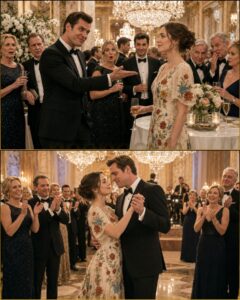
The woman in the hand-stitched dress.
The cream cotton. The rust vines. The blue flowers. The gold thread. The little houses leaning against the hem as though the mountains themselves had walked into the ballroom and taken the microphone.
Grant’s hands froze mid-applause.
His wineglass slipped.
It fell from his fingers, struck the marble floor, and shattered with a bright, delicate violence that would normally have turned every head in the room.
No one looked down.
Everyone was looking at Hannah Bellamy.
Grant could not move. He felt Preston stiffen beside him. The laughter from ten minutes earlier came back, not as sound, but as a blade sliding slowly between Grant’s ribs.
Onstage, Hannah accepted the applause without triumph. She did not search for Grant at first. She did not need to. That was the worst of it. He had tried to make her feel small, and now he understood that she had been standing in a room that existed partly because of her.
She adjusted the microphone.
“Thank you,” she said.
The room quieted.
“I know numbers have a way of impressing people in rooms like this. Ninety million dollars sounds large because it is large. It will build clinics. It will train nurses. It will stock pharmacies, pay teachers, fund transportation, and keep lights on in places where one broken-down van can decide whether a mother gets prenatal care or a miner gets diagnosed too late.”
She paused, letting the practical weight of the money settle before she changed direction.
“But tonight, I don’t want to talk only about money. Money is useful. Money can open locked doors. But money cannot create dignity where people refuse to recognize it.”
Grant felt the word strike him directly in the chest.
Dignity.
Hannah looked down at her dress, and when she touched the embroidered sleeve, her fingers were gentle.
“This dress was made by my grandmother, Ruth Bellamy, in a coal town outside Pikeville, Kentucky. She stitched it at night after cleaning houses, cooking for neighbors, and helping my grandfather keep the first Root & River clinic alive in two rooms behind a church. She made it from cotton she bought on sale and thread she saved in a coffee tin. Every flower on it took time she did not have.”
The ballroom had gone completely still.
“She did not make this dress to look rich,” Hannah said. “She made it to remember that beauty did not belong only to people who could afford to buy it finished. She used to say that expensive things prove someone paid. Handmade things prove someone cared.”
Grant’s throat tightened before he could stop it.
His mother had kept thread in a coffee tin.
Not because it was quaint. Because thread cost money.
A memory surfaced so sharply he almost stepped backward: his mother, June Calder, sitting at their kitchen table in West Virginia under a yellow lamp, mending uniforms for miners and waitresses, her fingers cracked from detergent and cold water. He remembered the tick of her needle through cloth. He remembered hating that sound. He remembered promising himself he would someday live in a world where no one could hear where he came from.
Hannah continued.
“My grandmother also told me that some people confuse price with value. Price is what a thing demands from your wallet. Value is what it asks from your conscience.”
Her eyes moved across the ballroom.
For half a second, they met Grant’s.
She did not accuse him.
That was almost unbearable.
If she had told the room what he had said, he could have become defensive. If she had humiliated him, he could have retreated into anger. But she did neither. She left him standing there with the full weight of himself.
The applause after her speech began slowly, then grew until the chandeliers seemed to tremble with it. People rose to their feet. Cameras flashed. Reporters surged toward the stage. Board members embraced her. Donors who had ignored her when she stood beside the champagne now waited for the privilege of touching her hand.
Preston grabbed Grant’s sleeve.
“We need to leave.”
Grant did not move.
“I said we need to leave,” Preston hissed. “Right now. Before someone recognizes where we were standing.”
Grant looked at him. “We?”
Preston’s face tightened. “Don’t get moral with me because your aim was bad.”
“My aim was perfect,” Grant said quietly. “That was the problem.”
Preston stared. “You are not thinking clearly.”
“For the first time tonight, I think I am.”
He pulled his arm free and started toward the stage.
He did not make it halfway.
Two foundation staff members stepped in front of him with smiles polished enough to cut glass.
“Mr. Calder,” one said, “Ms. Bellamy is speaking with invited press.”
“I need one minute.”
“I’m afraid she does not have one available for you.”
“I only want to apologize.”
The staff member’s smile did not change. “Then I suggest you begin by respecting her lack of availability.”
Grant stopped.
It was the first door in years that did not open because he stood before it.
Behind the staff members, Hannah was surrounded by people, but for one brief moment, she looked past them and saw him.
Grant did not know what his face showed.
Hannah’s expression revealed nothing.
Then she turned back to the reporters.
By morning, the video had twelve million views.
Someone had recorded everything. Not just the announcement. Everything.
Grant’s comment. Preston’s laugh. Hannah’s calm face. Her walk to the stage. The ninety-million-dollar revelation. The glass falling from Grant’s hand like a tiny prophecy.
The internet did what it always did when handed a perfect story. It built a fire and invited everyone to warm themselves.
The headlines were merciless.
BILLIONAIRE MOCKS WOMAN’S “CRAFT FAIR” DRESS—TURNS OUT SHE DONATED $90 MILLION.
THE MOST EXPENSIVE THING IN THE ROOM WAS HIS IGNORANCE.
HANNAH BELLAMY DIDN’T DRAG HIM. SHE LET HIS OWN WORDS DO IT.
By nine in the morning, three hospital executives canceled calls with Calder Holdings.
By eleven, a senator who had been photographed with Grant at a policy luncheon released a statement about “the importance of respecting rural American heritage.”
By noon, the Root & River Foundation formally suspended negotiations with Calder Holdings regarding the proposed Calder Center for American Renewal.
By one, Grant’s communications director, Elise, entered his office with red eyes and a folder full of statements no one wanted to sign.
Preston came in behind her without knocking.
Grant stood beside the floor-to-ceiling window of his Manhattan office, looking down at the city he had conquered one deal at a time. From the sixty-fourth floor, people looked small enough to become theoretical. That had always comforted him.
It did not comfort him now.
“We need to move fast,” Preston said. “You apologize to anyone offended, not to her directly. You say your remarks were taken out of context. You announce a new artisan entrepreneurship initiative. Ten million. Maybe fifteen. We flood the zone.”
Elise looked uneasy. “The phrase ‘taken out of context’ is risky. The context makes it worse.”