

The first time my heart truly broke, it didn’t do so quietly.
It was my sister.
Six years ago, I believed I was standing at the threshold of everything I had ever wanted. Nathan had a way of making certainty feel effortless. He was handsome in the polished, magazine-cover sort of way. Smart. Successful. Self-assured. He came from money, then made more of it himself, and people were drawn to him the way they are drawn to men who always look like they know exactly where they’re going.
I loved him.
Or maybe I loved who I believed he was.
Back then, it didn’t matter. I was engaged. I had a ring on my finger, seating charts in my kitchen drawer, and a wedding dress hanging in a garment bag in the back of my closet. Nathan wasn’t just my fiancé. He was the man I had built my tomorrow around.
I still remember the angle of the sunlight on the hallway floor. The sound of laughter drifting from the den. The faint scent of Stephanie’s perfume—sweet, expensive, unmistakable—where it had no business being.
When I stepped into the room, I saw them standing too close together. Far too close.Stephanie’s hand was on Nathan’s chest. Her head was tilted back in laughter. Nathan was looking at her with the same expression he used to wear when he looked at me, only this time it was sharper, hungrier, more alive.
No one moved.
No one rushed to explain.
And that was how I knew.
“Claire—” Nathan started.
But Stephanie, my younger sister, the girl I had once bandaged scraped knees for, the girl whose hair I used to braid before school, didn’t look ashamed. She looked calm. Almost relieved.
I stared at her, certain I had misheard. “Knowing what?”
Her mouth curved. Not kindly. Never kindly.
“That he doesn’t love you the way he loves me.”
Those words should have sounded absurd. Instead, they landed with sickening precision, because Nathan didn’t deny them.


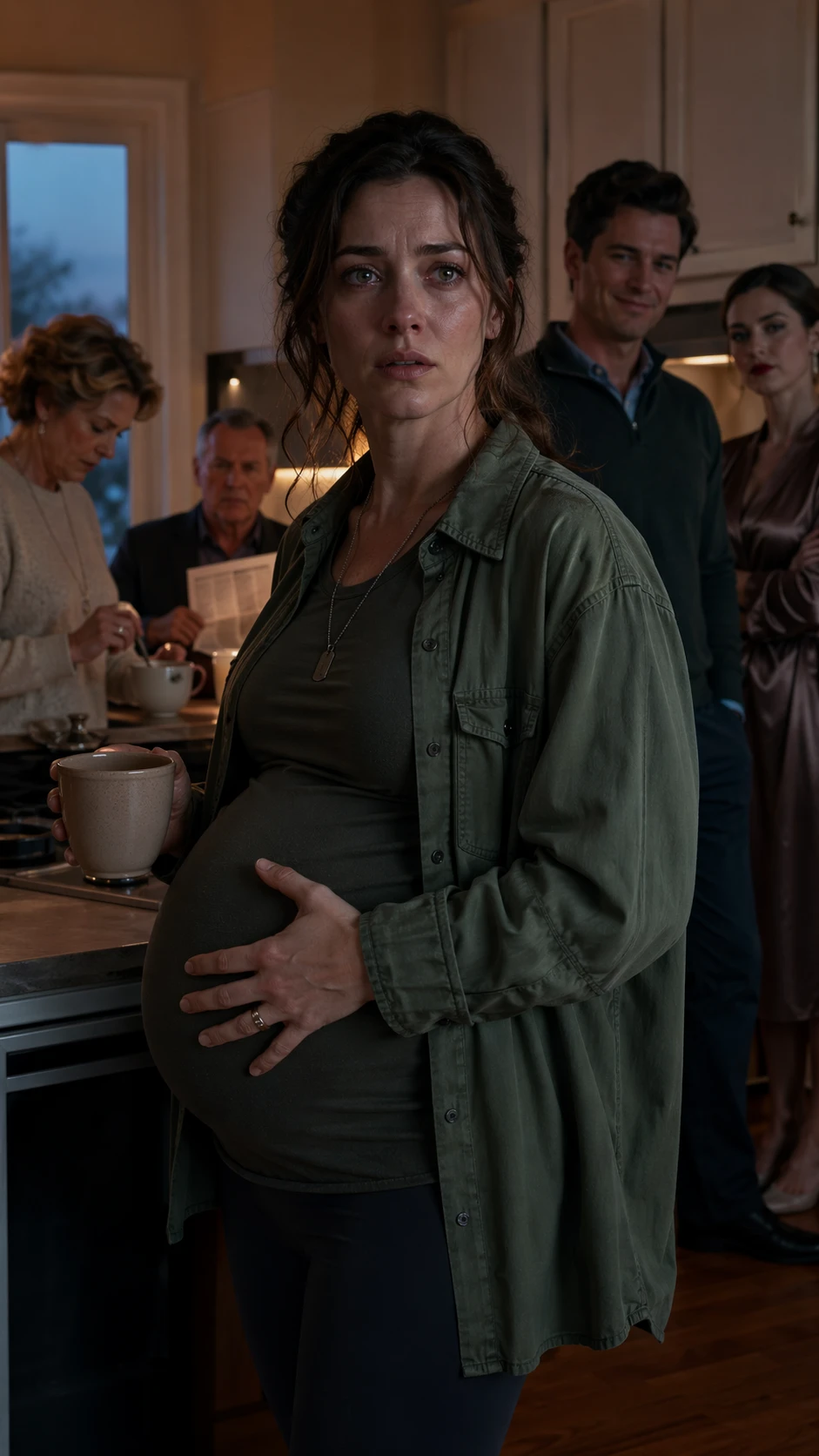
He didn’t even try.
Everything after that happened fast and yet with an unbearable slowness that made each moment feel carved into my skin. Nathan said things about timing and honesty and how feelings had “changed.” Stephanie said things about “chemistry” and “truth” and how no one could help who they fell in love with. My mother cried. My father shouted. I stood in the middle of the living room, numb from the neck down, while the two people who had detonated my life dressed their betrayal up as inevitability.
Within two months, Stephanie moved into the house he bought.
And within three, I left the city entirely.
Chicago was not a dream. It was an escape route.
I arrived in winter, with two suitcases, red eyes, and the kind of exhaustion that settles into bone.
I rented a tiny apartment with a radiator that hissed through the night and a view of a brick wall. I found work at a mid-sized architecture firm doing project operations, then worked my way up by becoming the one person no one had to worry about. I came early. Stayed late. Ate lunch at my desk. I became efficient, quiet, reliable.
Silence gave it somewhere to go.
I stopped answering questions about my personal life. I stopped dating after too many polite dinners with men who seemed offended by how little of me I was willing to give. I stopped going home for holidays when I knew Stephanie and Nathan would be there.
She never pushed too hard. That was her gift. She was gentle in ways the world rarely rewards. Every Sunday, she called and asked whether I was eating enough, whether Chicago was still cold, whether I’d bought better boots, whether I was sleeping.
I never answered that part.
Because some bridges don’t collapse. They are burned deliberately, by hand, while someone watches.
By the time she told me it was serious, she had already hidden it for months. “I didn’t want you worrying,” she said over the phone, as if that could soften the terror. I flew back twice that year, then three times more. Hospitals replaced distance. The old house smelled like antiseptic and wilted flowers. My mother grew smaller. Her voice grew thinner. But still, when Stephanie wasn’t there—and often she wasn’t—Mom would hold my hand and whisper, “Don’t let bitterness be the only thing that survives me.”
But not that.
When she died, the world did not stop. It should have. It absolutely should have. But it didn’t. Planes still departed. Coffeemakers still hissed. Phones still lit up. The cruelty of ordinary life after devastating loss is that it keeps moving as though your grief is a private inconvenience.
The church was heavy with white lilies and candlelight. Rain tapped softly against the stained-glass windows. Voices were kept low, shoes muted against polished wood. I stood near the front in black, accepting condolences I barely heard, my body functioning on memory alone.
Then the doors opened.
And there she was.
Stephanie.
Six years had sharpened rather than softened her beauty. She entered with the same impossible confidence she had always carried, as if every room were already hers by the time she crossed into it. Her black dress was elegant and expensive. Her hair fell in glossy waves. A diamond flashed on her left hand, large enough to look almost theatrical in the candlelight.
I had prepared myself for grief.
I had not prepared myself for that.
A cold, familiar ache swept through me, not because I still wanted him—I didn’t, not anymore—but because betrayal has a way of remembering itself in the body. My stomach tightened. My pulse kicked once, hard. For a split second, I was twenty-nine again, standing in my own home, watching my life being rewritten without my consent.
Stephanie saw me and smiled.
It was not a funeral smile. It was not the smile of a grieving daughter.
It was the smile of a woman who had come to measure the damage and enjoy what was left of it.
She approached slowly, Nathan beside her, and I became aware of people noticing. My aunt stopped speaking mid-sentence. A cousin looked away too quickly. Old family friends pretended not to stare.
“Claire,” Stephanie said, like my name tasted pleasant. “You look tired.”
I said nothing.
Her eyes flicked over me, cool and surgical. “I suppose grief does that. Though,” she added, glancing at my bare left hand, “so does being alone at thirty-eight.”
The cruelty of it was almost elegant.
Nathan shifted beside her, uncomfortable enough to notice, not brave enough to interrupt.
Stephanie lifted her hand just a little, letting the diamond catch the church light. “I got the man, the money, and the mansion,” she said lightly, as though discussing weather. “I guess some of us really do get the happy ending.”
Six years ago, those words would have gutted me.
Six years ago, I might have broken right there in front of everyone. I might have cried. I might have screamed. I might have given her exactly what she came for: proof that she still had the power to wound me.
Instead, I smiled.
It surprised even me, how easily it came.
Not a brittle smile. Not a trembling one. A calm, quiet, almost pitying smile that made Stephanie’s expression twitch before she could hide it.
Because while she had spent six years polishing the trophies she stole, I had spent six years becoming someone she could no longer predict.
I tilted my head and said, very gently, “Have you met my husband yet?”
For the first time since entering, Stephanie lost control of her face.
Nathan’s arm tightened on her waist. “Your what?” he said, too quickly.
I didn’t answer him.
I simply turned toward the side aisle and said, “Daniel?”
Footsteps moved across the stone floor.
Slow. Steady. Unhurried.
And then he stepped into view.
He was tall, elegant, wearing a dark suit that fit him like it had been made with intention. His hair was touched with silver at the temples. His expression was composed, almost unreadable, but there was warmth in his eyes when they found mine. He came to my side and rested one hand lightly against the small of my back with an intimacy so natural it made the entire room go still.
Stephanie went pale.
Not because Daniel was powerful-looking, though he was.
Not because he was handsome, though he was that too.
She went pale because she knew exactly who he was.
“Nathan,” Daniel said pleasantly, inclining his head. “Stephanie.”
Nathan’s face lost color one shade at a time.
My sister’s lips parted soundlessly before she managed, “No.”
Yes.
My husband was Daniel Whitmore.
Nathan’s father.
Silence hit the room like impact.
Even the rain seemed to disappear.
Nathan stared at Daniel as if his mind could not arrange the pieces into anything survivable. “This isn’t funny,” he said, but his voice cracked on the last word.
“It isn’t meant to be,” Daniel replied.
Stephanie turned to me so fast her heel slipped slightly on the stone. “You married his father?”
“No,” I said softly. “I married the man who spent the first year of our acquaintance treating me with more honesty than you managed in a lifetime.”
Nathan looked physically ill. “How long?”
Daniel answered that one. “A little over two years.”
Two years.
Which meant something Nathan clearly grasped a second later.
His eyes widened. “At the board retreat?”
I said nothing, but I remembered it.
Three years ago, my firm had been hired to oversee a restoration project for a philanthropic foundation housed in one of Chicago’s historic buildings. Daniel chaired the foundation. When we met, I knew his last name immediately. Whitmore. I knew the careful authority in his voice. I knew, from old photographs, the resemblance around Nathan’s mouth.
At first, I told myself it was coincidence.
Then he mentioned his son.
I should have walked away. Maybe a better woman would have. But Daniel was not Nathan. Where Nathan performed confidence, Daniel carried quiet certainty. Where Nathan withheld, Daniel listened. Where Nathan took, Daniel noticed. He knew pain without making spectacle of it. He recognized mine without asking me to display it for his comfort.
Our first conversations were formal. Then thoughtful. Then necessary. He knew who I was long before I knew he knew, and when he finally told me, I waited for shame or pity.
He offered neither.
Only this: “What happened to you was cruel. It should never have happened.”
I had not realized until that moment how badly I needed to hear someone say it plainly.
Months later, after dinners that stretched long past dessert and walks through winter streets and one breathtaking kiss I resisted and then didn’t, I asked him the question I had feared from the start.
“Why me?”
Daniel had smiled in that quiet way of his. “Because when you were betrayed, you became more discerning, not less kind. Because you know the cost of false love. And because when you look at me, Claire, I never feel mistaken for someone else.”
He proposed in private. No spectacle. No crowd. No performance.
Just truth.
And I said yes.
Now, in the church, the truth was finally standing in full view.
Stephanie looked from Daniel to me, then back again. The confidence she had worn like perfume was evaporating in real time. “You did this to humiliate us.”
I almost laughed.
“No,” I said. “You humiliated yourselves years ago. I just didn’t stop living afterward.”
Nathan turned on his father. “You married her to punish me?”
Daniel’s expression hardened, and for the first time there was steel in it. “I married Claire because I love her. As for punishment, Nathan, life seems to have arranged that on its own.”
That was when Stephanie made the mistake of grabbing Nathan’s arm and snapping, “Say something.”
And Nathan did.
But not to defend her.
He looked at her like he was seeing her clearly for the first time in years, all glitter scraped off. “Did you know?” he asked.
She blinked. “Know what?”
He gave a broken laugh. “About the trust.”
Daniel went still beside me.
“What trust?” Stephanie asked, too sharply.
Nathan swallowed. “The condition in my grandfather’s estate. The one about infidelity.”
A faint murmur moved through the nearby guests.
Daniel closed his eyes for one second, like a man watching an inevitability arrive.
I frowned. “Nathan?”
He looked at me, and what I saw there was not love, not remorse, but ruin.
“My grandfather left the family controlling interest in Whitmore Holdings in trust,” he said hoarsely. “It transfers fully to the heir only if the marriage remains legally intact and free from proven infidelity for seven years.”
Stephanie’s face emptied.
I stared at him. “You’re lying.”
“I wish I were.” His voice broke completely now. “Three months ago, the private investigator’s report was filed.”
Daniel spoke with cold precision. “Stephanie has been having an affair for eighteen months. With your interior designer, if I recall correctly.”
The church spun.
Stephanie recoiled as if struck. “How dare you—”
“Oh, stop,” Daniel said, his tone cutting through hers like glass. “You forget, Stephanie, lies repeat themselves. Patterns are easy to spot in people who never believe consequences apply to them.”
Nathan’s breathing turned shallow. “The report voided the transfer. The board acted this morning.”
“This morning?” Stephanie whispered.
Daniel looked at her without mercy. “Whitmore Holdings is no longer Nathan’s to inherit.”
Nathan’s shoulders caved inward. “The mansion is in a holding entity tied to the trust,” he said, staring at the floor. “The accounts too. Everything.”
Stephanie’s diamond hand began to shake.
“No,” she said. “No, you said we were secure.”
“You were secure in appearances,” Daniel replied. “Not in character.”
She looked at me then—really looked at me—and for the first time in six years, I saw it.
Not superiority.
Not victory.
Fear.
Raw, naked, panicked fear.
And then, because fate was not yet finished, my mother’s lawyer—who had been seated quietly in the second pew all along—rose and stepped forward.
“I believe,” he said gently, “this is the appropriate moment.”
He handed me a sealed envelope.
My name was written on the front in my mother’s delicate hand.
My fingers trembled as I opened it.
Inside was a brief letter and a notarized amendment to her will.
Claire, it began. If you are reading this, I am gone, and I pray grief has not blinded you to truth. I loved both my daughters, but love is not blindness. I knew who stood by me, and I knew who only arrived when cameras could witness devotion.
My throat closed.
The house is yours. The lake property is yours. And the remainder of my personal estate is yours alone. Not because you suffered more, but because you stayed when staying was hardest.
Stephanie made a strangled sound. “She wouldn’t do that.”
The lawyer met her gaze. “She did.”
There, in the front of the church, beneath flowers meant for mourning, my sister lost everything she had built her identity around in the span of a single afternoon.
The man she stole.
The money she flaunted.
The mansion she weaponized.
The illusion that winning once meant winning forever.
She stepped backward, one heel catching, Nathan too stunned to steady her. The diamond on her hand flashed wildly as she reached for balance, and all I could think was how strange it was that the very thing she had once lifted like a trophy now looked like shackles.
I should have felt triumphant.
Instead, I felt something quieter.
Release.
Not because she had fallen. Not because I had risen. But because for the first time in six years, her choices no longer had the power to define my story.
I folded my mother’s letter carefully and pressed it against my heart.
Then I looked at Stephanie and said the truest thing I had spoken all day.
“You didn’t steal my future. You only stole the version that was never meant to survive.”
Daniel’s hand found mine.
Outside, the rain finally stopped.